
The fastest-moving shift in online retail is not another chatbot. It is the rise of ai agents ecommerce 2026 strategies where software can reason, plan, and execute buying journeys with minimal manual clicks. This practical guide explains what agentic commerce means, where it creates real value, and how Shopify and WooCommerce stores can implement it without breaking operations.
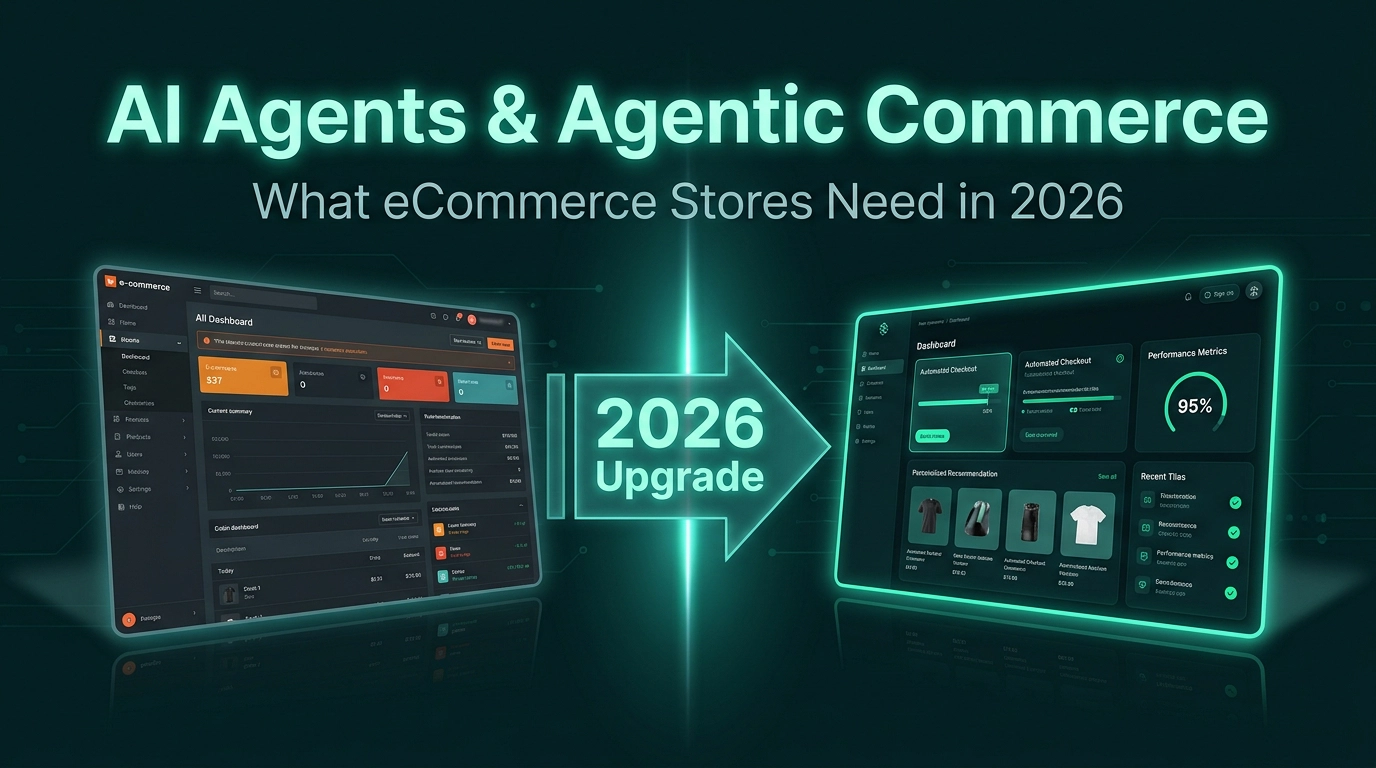
Agentic commerce is an operating model where AI agents do more than recommend products. They can understand intent, compare options, execute tasks, and learn from outcomes. In simple terms, the store experience shifts from "search and click" to "state your goal and let the system orchestrate the path."
That is why the phrase ai agents ecommerce 2026 matters. It signals a practical transition from rule-based automation to autonomous systems that can plan decisions in real time across merchandising, personalization, support, and conversion.
Three market shifts are converging: better multimodal models, lower inference costs, and stronger eCommerce platform APIs. Together, they make production-grade agents feasible for mid-size stores, not just enterprise teams.
Agents can now reason across catalog data, reviews, price constraints, and customer context with fewer hallucinations than earlier generations.
Shopify and WooCommerce ecosystems now support richer event hooks, webhooks, app integrations, and fulfillment automation needed for agent workflows.
In short, agentic commerce trends in 2026 are moving from experimentation to measurable ROI. Stores that start with narrow, high-value workflows will gain an operational edge quickly.
For most teams, deployment is hybrid. The agent handles decisions and orchestration, while platform-native tools execute checkout, inventory, tax, and payment logic.
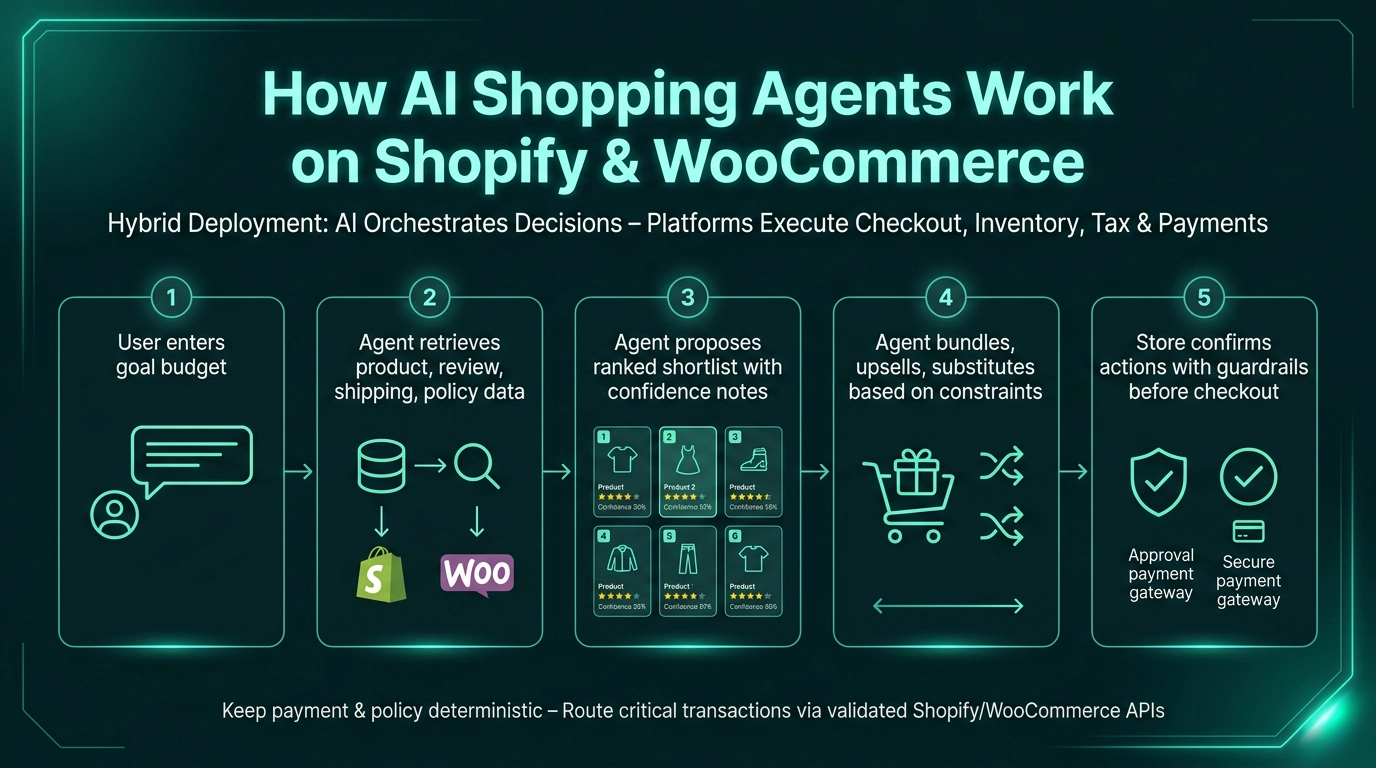
You do not need a full autonomous storefront on day one. Start with focused workflows that directly impact revenue, conversion rate, and support load.
Agents ask clarifying questions and build dynamic shortlists, increasing conversion for large or complex catalogs.
Agents apply bundle logic, accessory pairing, and margin-aware alternatives before checkout.
Agents handle delivery updates, returns guidance, and reorder suggestions while reducing support tickets.
For ai agents personalized shopping 2026, agents tailor messaging and offers by stage, intent, and behavioral signals.
Use a phased rollout to control risk and prove value quickly. The roadmap below is practical for service teams and in-house eCommerce operators.
| Phase | Objective | What to build | Success signal |
|---|---|---|---|
| Phase 1 (Weeks 1-3) | Pilot a narrow agent task | Discovery assistant on top category | Higher qualified product views |
| Phase 2 (Weeks 4-8) | Connect commerce actions | Cart optimization with fallback rules | AOV lift and fewer cart exits |
| Phase 3 (Weeks 9-12) | Add lifecycle intelligence | Post-purchase and retention agent | Repeat purchase rate increase |
| Phase 4 (Ongoing) | Scale and govern | Monitoring, policy, QA, experimentation | Reliable ROI with low incident rate |
This phased model is the core of an autonomous ai ecommerce guide that works in real stores, not just labs.
Measure impact at each step. If you cannot quantify outcomes, agentic commerce stays a novelty instead of a growth system.
Agentic systems should never be fully unconstrained in commerce operations. Put hard limits in place from day one.
Unapproved discounts, weak product substitutions, or policy conflicts caused by over-automation.
Use strict action scopes, confidence thresholds, human override, and audit logs for every high-impact decision.
Stores that combine speed with policy control will win. The objective in ai agents ecommerce 2026 is not maximum autonomy. It is maximum reliable value.
It refers to eCommerce workflows where AI agents can reason and execute tasks such as discovery, personalization, and orchestration, while core transactions stay controlled by platform rules.
No. Mid-size Shopify and WooCommerce stores can adopt agentic workflows in phases, starting with one category or one conversion bottleneck.
Chatbots answer questions. Shopping agents can plan multi-step decisions, trigger actions, adapt to constraints, and optimize outcomes across the purchase journey.
Start with one measurable use case such as guided product discovery, set clear success KPIs, then expand only after control and reliability are proven.
Agents adapt recommendations to intent, context, and constraints in real time, which reduces decision friction and increases basket quality.
I design and build custom WooCommerce and Shopify solutions with performance-first architecture, scalable automation, and conversion-focused UX.